
Sarah is 36. She came to see me a few weeks ago with a large, painful lump in her left breast. Her ultrasound showed a complicated breast cyst (benign, not cancer). And yet we still took her to theatre and removed it.
If your breast lump is not cancer, you might be wondering the same thing Sarah’s family asked me: if it’s benign, why remove it at all? Size, atypical features on imaging, nipple discharge, rapid growth, ongoing pain, or a lump in a man are the six situations where a specialist breast surgeon will usually recommend surgery over simply watching and waiting. We’ll walk through each one below, along with what a benign lump typically feels like, and the tests your doctor uses to be sure.
Quick Answer
- Roughly 9 in 10 breast lumps turn out to be benign, but every new lump still needs a proper medical work-up before anyone relaxes.
- Learning your breast lump is not cancer doesn’t automatically mean the story ends there. Some benign lumps still need to come out.
- A benign lump often feels soft, smooth-edged and movable, while a cancerous lump tends to feel hard, irregular and fixed in place.
- Doctors rely on the “triple test” (a physical exam, imaging, and (where needed) a biopsy) to work out what a lump actually is.
- Even once cancer is excluded, a benign breast lump signs its own case for removal if it’s growing, has atypical features, is discharging fluid, belongs to a man, is growing fast, or is causing ongoing pain.
- Deciding when to remove a benign breast lump is a judgment call best made with a specialist breast surgeon, not something to guess at home.
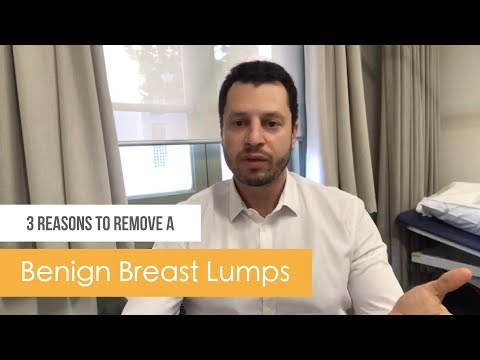
Click to hear Dr. Yunaev talk about the 3 reasons to remove a benign breast lump
Confirmed Your Breast Lump Is Not Cancer? Here’s What Benign vs Cancerous Feels Like
It’s a heart-sink moment, feeling a new breast lump. Around 1 in 8 Australian women will be diagnosed with breast cancer in their lifetime, so treating every lump as suspicious until proven otherwise is the right instinct, even though around 90% of breast lumps turn out to be benign.
However, plenty of lumps that are proven beyond a doubt to be benign still end up needing surgery. People often ask if they can tell the difference just by touch. Partially, yes, but only partially.
Benign lumps, like simple cysts and fibroadenomas, tend to feel smooth, round, soft to firm, and easy to move under the skin. They may come and go, change with your menstrual cycle, or be tender rather than painless.
A lump that’s more likely to be cancer tends to feel hard, have an irregular shape, and stay fixed in place rather than sliding under your fingers. It’s often (though not always) painless.
That’s a useful general pattern, but it’s not a diagnostic tool. The only way to know for certain is imaging and, where indicated, a tissue sample.
The Triple Test: How We Work Out What a Lump Is
Every breast complaint should start with the same three-part assessment: a thorough clinical history and physical exam, breast imaging (a mammogram and/or ultrasound), and, in some cases, a biopsy. Together, these three steps make up what’s known in benign breast conditions management as the triple test.
Not every lump needs a biopsy straight away. Sometimes, the safer, less invasive path is to reimage the area after a set interval to check nothing has changed. Other times, particularly if there’s any doubt, a specialist breast surgeon referral is the right next step.
Once the triple test confirms your breast lump is not cancer, a different question comes up. Even with a benign result, should this lump come out?
Deciding if a lump needs to be cut out or simply monitored is often best handled by a specialist breast surgeon. Here are 6 benign breast lump signs that mean a surgeon should be involved in your care, even once cancer is off the table.
1. It Changes Size
When a benign lump being monitored over time grows, removing it to examine the whole thing under the microscope is often the only way to confirm there’s no cancer hiding within it. This scenario comes up often with fibroadenomas, which make up roughly 12% of all breast lumps, particularly in women aged 21 to 25.
Fibroadenomas are extremely common and sometimes picked up incidentally during a routine breast assessment. “They can be managed conservatively, most of the time,” says Dr Yunaev, “but if there’s a progressive increase in the size of the lesion, or if it’s larger than 2.5–3cm, excision should be considered.”
2. It Has Atypical Features on Imaging
A breast cyst is one of the most common ultrasound findings in a benign breast lump. Most of the time, all it needs is reassurance. But a specialist surgeon may still recommend removal, particularly if the cyst is large, keeps coming back, or the imaging and biopsy assessment flags “atypical features,” meaning cancer can’t yet be fully excluded.
3. It Discharges Fluid
A nipple discharging clear or bloody fluid should always be assessed by a specialist breast surgeon. Only a small proportion of the underlying growths (usually papillomas) actually carry cancer risk, but every case still needs surgical investigation to rule out cancer and remove the papilloma.
4. It Belongs to a Man
Gynaecomastia (enlarged male breast tissue, sometimes called “man boobs”) is common and can be distressing psychologically, which alone can justify surgery. But there’s a second, more serious reason a lump in a man needs proper assessment: it can sometimes be mistaken for straightforward gynaecomastia when it’s actually the rare but deadly male breast cancer. Any man with a new breast lump needs a full work-up before anyone assumes it’s simply gynaecomastia.
5. It Grows Rapidly
Fast-growing lumps make everyone nervous for a reason. Pseudoangiomatous hyperplasia (PASH – a benign overgrowth of breast connective tissue) can grow quickly, sometimes turning up incidentally on a biopsy done for another reason, or as the cause of a large new lump. While generally benign, PASH can mimic a fibroadenoma, a phyllodes tumour (a rare, usually benign but occasionally aggressive breast growth), or even angiosarcoma (a genuine cancer). Because it can grow rapidly to a significant size and cause real distress, it’s often better to remove it than to watch it grow.
6. It’s Symptomatic
Sometimes a lump is confirmed benign but still causes real discomfort or pain, particularly around your menstrual cycle. That alone is often reason enough to remove it. Nobody should have to put up with a painful, tender lump for years on end just because the pathology report says “benign.”
When to Remove a Benign Breast Lump: Talk to a Specialist
Knowing when to remove a benign breast lump isn’t something you should have to work out alone. If you’re uncertain or concerned about a lump that’s growing suspiciously, discharging, or causing ongoing discomfort, the safest next step is a specialist breast assessment. A specialist can weigh up your imaging, your history and your particular circumstances to help you decide whether it’s genuinely safe to leave a lump alone, or safer to have it out.
This decision matters just as much when cancer is confirmed. If you are diagnosed with breast cancer, the same surgical skill set applies to preserving as much natural breast tissue as possible, whether that’s through a breast lumpectomy or oncoplastic breast surgery, which combines cancer removal with techniques to preserve the breast’s natural shape. For women who do need a mastectomy, breast reconstruction is also an option worth discussing early, not as an afterthought.
You can read more about the full range of options for breast cancer treatment or the benefits of lumpectomy over mastectomy on our site.
Book A Consultation With Dr Yunaev
Dr Yunaev always tells his patients the same thing: if you’re unsure whether a benign-looking breast lump is growing suspiciously or causing you grief, get a referral to a specialist breast surgeon. Recognising the benign breast lump signs above is a good start, but deciding when to remove a benign breast lump is a call that’s much easier to make with someone who does this every day, rather than trying to weigh it up on your own.
If you’ve been told your lump is benign but you’re still not sure whether it should be removed or simply watched, book a consultation with Dr Yunaev’s team at Breast & Body Clinic. We’ll talk you through your imaging, your history, and the options, so the decision is informed rather than a guess.









 Ask a Question
 Call Us
 Book a Consult